Power plugs around the world — voltages, pin layouts and what adapters to pack
Phones, GPS units, intercoms, e-bike batteries, laptops — every multi-country tour leaves a trail of devices looking for a socket. The plug fit is rarely the problem; the voltage and frequency are. This is a practical reference to the plug types riders and cyclists actually meet on a tour, plus what to pack so the only thing that fails in your hotel is the Wi-Fi.
The plug types you'll actually meet
The IEC technically defines 14 plug types (A–O). For touring purposes you'll meet maybe nine. The rest you can ignore — your universal adapter has them anyway.
Type A — North American flat blades
Pins: Two parallel flat blades, ungrounded. One blade slightly wider than the other on modern plugs (polarised).
Where: USA, Canada, Mexico, most of Central America, parts of South America (Colombia, Venezuela, Ecuador), Japan (Japan-only at 100V/50Hz or 60Hz depending on region).
Often interchangeable with Type B sockets. Older sockets accept Type A only; modern ones accept both.
Type B — North American grounded
Pins: Two flat blades plus a round earth pin below, forming a 'face' shape. Earth pin protrudes ~3mm beyond the blades so it makes contact first.
Where: USA, Canada, Mexico, Japan (rarer than Type A), and increasingly common in Central America for high-draw appliances.
All laptop chargers and most modern electronics use Type B. A Type A travel adapter often won't fit a Type B brick.
Type C — Europlug
Pins: Two round 4mm pins, 19mm apart, ungrounded. Rated max 2.5A — the small thin plug you see on phone chargers and lamps.
Where: Nearly all of continental Europe, plus parts of South America, Asia, Russia and the Middle East. Almost universally accepted as a 'fits in any European socket' standard for low-draw devices.
Type C plugs fit into Type E, F, J, K, L and N sockets. The thing every European phone charger has by default.
Type F — Schuko
Pins: Two round 4.8mm pins, 19mm apart, with earth contacts as clips on the top and bottom edges. Plug is recessed into the socket.
Where: Germany, Austria, Netherlands, Sweden, Norway, Finland, Spain, Portugal, Greece, Russia, Turkey, most of Eastern Europe.
Functionally the European standard for any device that draws more than ~2.5A. A Type C plug fits a Type F socket; a Type F plug doesn't fit a Type C socket.
Type G — British 13A
Pins: Three rectangular flat pins in a triangle: live and neutral on the bottom, longer earth pin on top. Plug includes a replaceable fuse (usually 3A or 13A).
Where: UK, Ireland, Malta, Cyprus, Hong Kong, Singapore, Malaysia, Gibraltar, the UAE (alongside Type C/F).
The chunkiest and arguably safest domestic plug in the world. The earth pin opens shutters over live and neutral — kids can't poke things in.
Type I — Australian / Chinese
Pins: Two flat pins at an angle (inverted V), plus a vertical flat earth pin below. Looks like an angry face.
Where: Australia, New Zealand, China, Argentina (Argentina reverses live and neutral). Fiji and PNG also use it.
Australia, NZ and China use the same plug shape — but Australian appliances are NOT certified for use in China and vice versa, because the safety/compliance regimes differ.
Type J — Swiss
Pins: Three round 4mm pins in a wide offset triangle — two close together for live/neutral, earth pin sits ~5mm to the side and is offset from centre.
Where: Switzerland, Liechtenstein, Rwanda, the Maldives (alongside Type D/G).
Almost-but-not-quite a Type C — a Type C plug fits a Type J socket, but a Type J plug won't fit anything else in Europe. Switzerland is the one alpine country where you'll want a proper adapter.
Type L — Italian
Pins: Three round pins in a horizontal line, earth in the middle. Comes in 10A (small, 4mm pins) and 16A (large, 5mm pins) variants — they're not interchangeable.
Where: Italy, Chile, Uruguay, parts of North Africa (Libya, Ethiopia).
Modern Italian buildings increasingly use 'Schuko-compatible' sockets that accept Type C, F, and L. Older buildings have Type L only. Hotels almost always have both.
Type N — Brazilian
Pins: Three round pins in a triangle — two for live/neutral (4mm), earth pin in the middle and slightly higher. Almost identical to Type J but with the pins closer together.
Where: Brazil, South Africa (newer installations).
Brazil is split — north and northeast typically 127V, south typically 220V. Check the socket label at the hotel. A dual-voltage charger handles both; a kettle or hairdryer doesn't.
By region — what to expect
North America (US, Canada, Mexico)
Types A and B. 120V at 60Hz. Bring a UK→US adapter and check every device for '100–240V' on the brick. A British kettle plugged in via adapter to 120V will boil at quarter speed but still work. A British hairdryer often won't power on. Power strips with USB ports are universal in airports and hotels.
Western Europe (France, Germany, Spain, Netherlands…)
Types C and F. 230V at 50Hz. UK plugs need an adapter (UK→EU 'tourist' adapter, the cheap ones are everywhere in airports). A Schuko-style adapter is better than a Europlug-only one for higher-draw devices like laptops. France, Belgium, Czechia, Slovakia and Poland also use Type E sockets which take both C and F plugs.
UK and Ireland
Type G. 230V at 50Hz. The chunky three-pin with the fuse. If you're coming from Europe, a Schuko→UK adapter is essential and absurdly bulky. Universal adapters with a built-in fuse (e.g. SKROSS, Mu Lite) are worth the extra money.
Switzerland
Type J. 230V at 50Hz. Looks like a Type C but with an offset earth — a standard EU plug won't fit a Type J socket. Hotels often have at least one universal socket, but if you're staying in alpine refuges, pack a UK→Swiss or EU→Swiss adapter.
Italy
Type L (and increasingly Type F). 230V at 50Hz. Modern hotels have hybrid sockets that take C/F/L. Older hotels and apartments may be Type L only. The Italian 10A and 16A variants of Type L are NOT interchangeable — the 16A is for ovens and air-con, not chargers.
Australia & New Zealand
Type I. 230V at 50Hz (Australia) / 230V at 50Hz (NZ). Same plug as China but the appliances aren't legally interchangeable. Sockets often have a built-in switch — flip it on or your charger does nothing.
Japan
Types A and B. 100V — the lowest standard voltage in the world. Frequency splits east/west: 50Hz in Tokyo and the north, 60Hz in Osaka and the south. Most modern electronics tolerate both, but anything with a motor (electric razor, certain old hairdryers) might run wrong-speed on the 'other' side of the country.
Brazil
Type N. Voltage is the trap: 127V in the north and northeast (Rio, Salvador, Recife, most of the Amazon), 220V in the south (São Paulo down to Argentina). Each socket should be labelled — read it. Mid-tier hotels often have both.
What to actually pack
For European-only tours, one UK→Schuko (or vice versa) adapter does the job. For anything further afield, a single universal adapter saves the day.
Universal travel adapter
Mu Lite (sliding-pin design, pocket-sized) or Mogics Donut (built-in USB ports and a small ring of outlets) are the two cult picks. Avoid the cheapest Amazon adapters — counterfeits are common and the live pin can slip back into the body. Spend £20–30 once.
USB-C PD wall brick
65W minimum if you charge a laptop, 30W if you only do phones and intercoms. A single GaN brick (Anker 736, UGREEN Nexode 65W) covers everything from a phone to a MacBook Pro. Use the local socket via your travel adapter.
Bike-side 12V → USB
A hardwired 12V→USB-C charger on the bike (Quad Lock dual-port, SAE-to-USB pigtail off the battery) keeps phones, GPS units and Bluetooth intercoms topped up while you ride. Most touring kit never sees a wall socket — only the hotel evening does.
What to leave at home
Hairdryers, kettles, electric razors that aren't dual-voltage. Anything labelled '120V only' on the brick will buzz, smoke or pop a fuse on European 230V. Anything labelled '230V only' will run at a quarter-power on US 120V. Read the small print on the brick before packing.
Voltage vs frequency — the actual risk
The brick label
Look on the small text of any charger: '100–240V, 50/60Hz' means it works everywhere. '230V, 50Hz only' means do NOT plug into a US socket. '120V, 60Hz only' means do NOT plug into a European socket. Almost every modern phone, laptop, camera and bike-comms charger is dual-voltage. Almost no kitchen appliance is.
Why frequency rarely matters
50Hz vs 60Hz only matters for AC motors (older fans, some electric razors, mechanical clocks) and certain transformers. Modern switched-mode power supplies — anything with a small black brick on the cable — don't care. The brand-new e-bike charger or laptop PSU just sees DC after rectification.
What a step-up/step-down converter is
A heavy box that converts 120V→230V or 230V→120V. Required if you're insistent on bringing a 120V kettle to Europe. Heavy, expensive, often poor quality. Almost always cheaper to buy the equivalent appliance at the destination.
Related guides
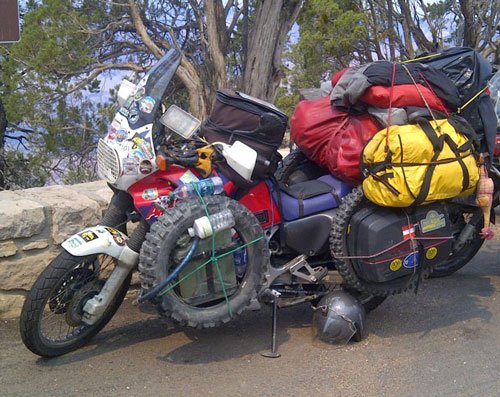
What to pack for a motorbike tour in France, Germany, Switzerland and Italy
A rider's checklist for European touring: documents, country-specific legal kit, riding gear, tools, navigation, comfort, money, medical, and the day-before checks.
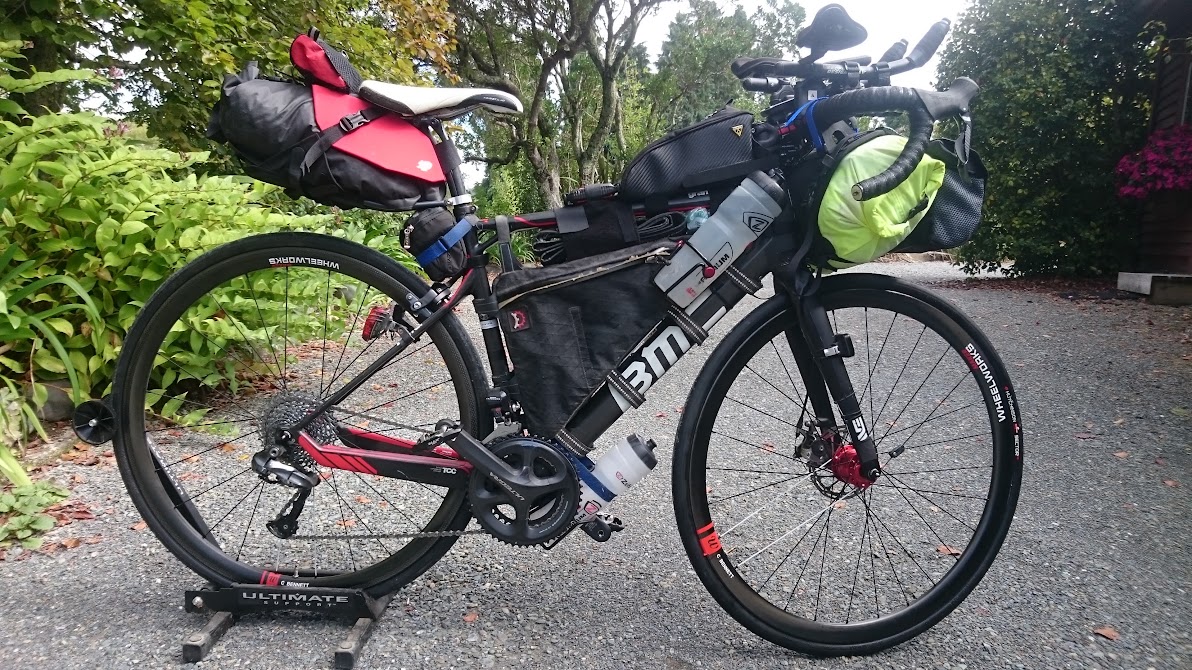
What to pack for a cycle tour through France, Germany, Switzerland and Italy
A cyclist's checklist for cross-border European touring: documents, country-specific cycling rules, kit, the bike itself, tools, navigation, comfort, and the day-before checks.
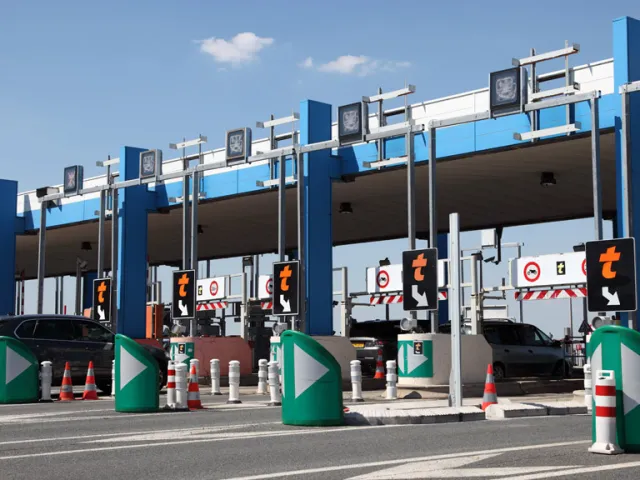
How to use French toll roads on a motorbike
How the péage system works, which lane to use, Liber-t electronic tags, the new Flux Libre barrier-less rollout, group ride logistics, and how to keep costs sensible.